
Tuesday, January 28, 2014

Monday, January 27, 2014
WHAT'S THE STORY?
Just being honest here. I do not know a thing from a tale of two cities and it's quite confusing...
HELP!
HELP!
Lit Analysis #1 Semester 2
SIDDHARTHA
CHARACTERIZATION
1. Describe two examples of direct characterization and two examples of indirect characterization. Why does the author use both approaches, and to what end (i.e., what is your lasting impression of the character as a result)?
2. Does the author's syntax and/or diction change when s/he focuses on character? How? Example(s)?
3. Is the protagonist static or dynamic? Flat or round? Explain.
4. After reading the book did you come away feeling like you'd met a person or read a character? Analyze one textual example that illustrates your reaction.
By: Hermann Hesse
1) A man name Siddhartha is born in a Brahmin family. He's loved and very well known but it's satisfied with his beliefs and decided to leave and join the Samanas. His close friend Govinda goes with him. After a couple years they are still unsatisfied with their beliefs and decided to listen to the teachings of Gotama. Siddhartha still unsatisfied leaves Govinda and he's now alone. Then he finds a women name Kamala. Siddhartha works to give her what she wants. After all the lust and wealth that he obtained while being with Kamala he leaves his home and never returns. After contemplating on suicide Siddhartha sees his friend Govinda after years and years. Siddhartha then finds a ferryman named Vasudeva and Siddhartha becomes wiser and wiser. He then helps Govinda find arrive enlightenment.
2) The theme of the book is wisdom and knowledge. Finding your spirit from within.
3) The tone of the book is very formal.
4) Imagery: "In the shade of the house, in the sunshine on the river bank by the boats, in the shade of the sallow wood and the fig tree, Siddhartha, the handsome Brahmin's son, grew up with his friend Govinda."
4) Imagery: "In the shade of the house, in the sunshine on the river bank by the boats, in the shade of the sallow wood and the fig tree, Siddhartha, the handsome Brahmin's son, grew up with his friend Govinda."
Metaphor: "Om is the bow; the arrow is soul; Brahmin is the arrow's mark."
Simile: "Awaited in a new thirst like a hunter in the gap."
Simile: "Awaited in a new thirst like a hunter in the gap."
Personification: "Ask the river and hear its counsel for yourself."
CHARACTERIZATION
1. Describe two examples of direct characterization and two examples of indirect characterization. Why does the author use both approaches, and to what end (i.e., what is your lasting impression of the character as a result)?
2. Does the author's syntax and/or diction change when s/he focuses on character? How? Example(s)?
3. Is the protagonist static or dynamic? Flat or round? Explain.
4. After reading the book did you come away feeling like you'd met a person or read a character? Analyze one textual example that illustrates your reaction.
it's been a while... MUSIC MONDAY!!!
But, it's sooo good and I rediscovered it. Enjoy.
Happy Monday!
WHY DO WRITERS WRITE?
It was a unproductive Saturday night this weekend and after coming home from eating fries with a friend I decided to watch a movie on Netflix. Right on the Netflix dashboard a new movie Stuck in Love was being promoted. I watched it and it was your typical chick flick but it just made me realize how much I love to write about my life and past experiences. I'm not the best writer because I just tend to ramble but it made me realize how much I want to write a book when I'm older and much wiser. And in class today we discussed about writing and the difference between fiction and telling a lie and it brought me to this topic. And the question is "Why do writers write?" I don't know why I write but it's something I will definitely keep in mind.
Monday, January 13, 2014
Henry V

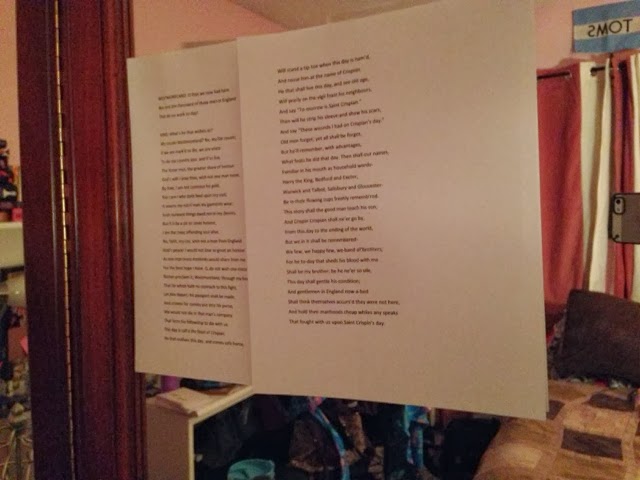
Although we were assigned this passage on Friday and we don't have much time I decided to take Lisa Malin's advice. (I'll link later) I read her post on how she memorizes things and so I gave it a shot. I'm super determined on getting this whole thing down. It's been a challenge for me and I hope this technique works! Thanks again Lisa! :)
Saturday, January 11, 2014

Subscribe to:
Posts (Atom)